There are rooms within Nocturna That even Nocturna Does not admit to having.
Rooms whose doors Have never been recorded In any architect’s plan, Nor mentioned In the club’s oldest ledgers.
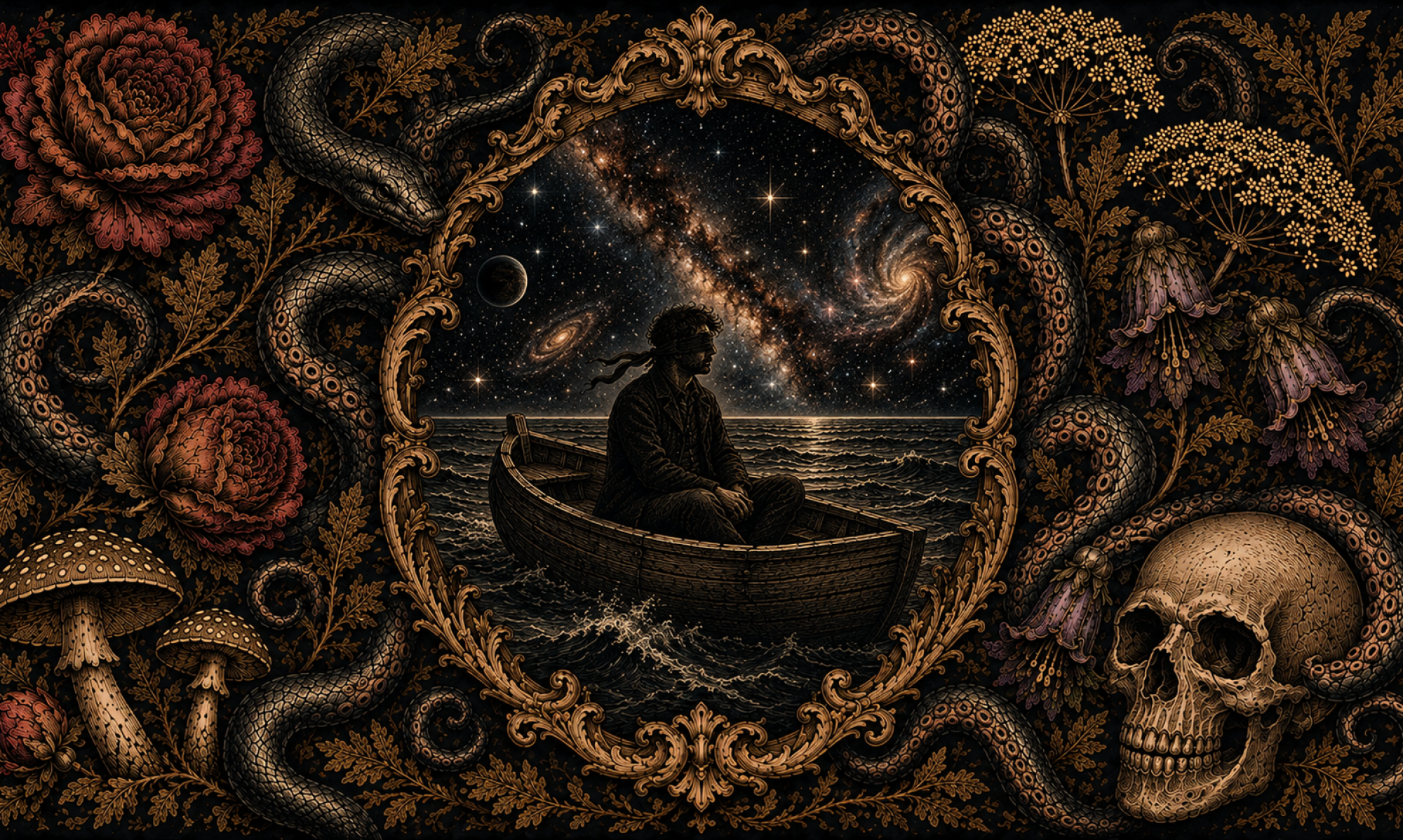
One such room may be found In the library.
Or rather, Behind a bookcase In the farthest corner Where dust gathers Upon forgotten volumes, And the gaslight Seems always A little reluctant to reach.
On the first floor of Nocturna, Hidden behind a large painting, Is a secret sleeping room.
A quiet place where members come to surrender the waking world, close their eyes, and wander wherever dreams choose to take them.
This evening, Alistair Fisk has gathered a small group to discuss the great mysteries of history, and perhaps encourage a particularly memorable night’s sleep.
Mahogany panels, Carved with crescent moons, Cover the walls of Nocturna‘s Smoking Gallery.
Three magnificent cabinets Contain cigars from every corner Of the known and unknown world. Along neighbouring shelves, Leather tobacco pouches Hold blends Both local and obscure.
Some fragrant. Some peculiar. And several that Edgar Brillows Has specifically requested Never be smoked Near the curtains.
Three times yearly, When the moon reaches an agreeable position, The members gathered Before the great carved oak doors That separated The warmth of Nocturna From its hidden courtyard.
The lanterns burned softly. Perfume drifted beneath the ancient arches. Someone coughed politely. Someone else Had already begun drinking…
Whenever the engine Of Denham Carter-Smythe’s impossible motorcar Echoed along Selwyn Lane,
Nocturna barman Edgar Brillows instinctively Straightened his waistcoat. Not because of Denham. Because of his nurse.
Denham Carter-Smythe A keen cartophilist, Visits the club once a month, Ready to trade and purchase antique maps, Of unusual or exotic places.
Denham himself is quite the antique now, Following a very long life of adventure, He is now wheelchair bound. This old wooden Victorian chair is pushed into the club by is private nurse.
He spends his evening trading maps, Secrets, and leatherbound volumes.
Denham is a small ancient grey haired man, Dressed in a long burgundy house coat, with a matching fez perched upon his head, Small round small spectacles balance on the end of his nose, and his legs are covered in a dark wool blanket.
He is wheeled into his booth, To conduct the evenings business. His nurse then makes her way to the bar, To a particular swivel stool in a dark corner, To await the gentle tinkle of Denham’s tiny bell.
Frau Olga Knochen, A large intimidating Austrian woman, Standing over six feet tall. She is as much nurse, as she is Denham’s protector.
Her dark hair is slicked back into a tight bun. Rumoured to be a former psychiatric hospital Matron. She is also an avid amateur chiropractor, Who delights in the sounds of cracking backs.
She is unnaturally strong, With powerful hands. Her dark judgmental eyes, Constantly survey other patrons, With a look of displeasure on her face.
Her deep gravelled voice seems like, It should belong to an angry longshoreman, Rather than a personal carer, She has been known to ask patrons,
“You want crack back?”.
Appearances aside, she is very attentive to, The collector who she refers to as ‘Mr Denham’.
It is rumoured that she once Carried her wheelchair-bound employer Effortlessly up three flights of stairs… Wheelchair included.
Olga always situates herself, At the nearby bar, Close to barman Mr Brillows, Where she can converse And closely observe, For she is quite infatuated with him.
Edgar Brillows always greets her with “Good evening, Frau Knochen. Your usual?”
She smiles briefly with a nod, and the barman slides across A delicate crystal glass of sour apple schnapps.
After several glasses, She fondly refers to him as her Mausi or little mouse. To which he politely remains professional. It’s that aloof yet engaging professionalism, That holds Frau Knochen’s utmost attention.
Dressed in an old grey matron’s uniform With a black knitted shawl cast across her wide shoulders. This mountain of a woman is formidable. And would love to nothing more,
Than to squeeze the life out of the charming Mr Brillows, With affection.
Some time passes before the barman can breathe a sigh of relief, As the tinkle of a tiny crystal bell tolls, Olga empties the last of her schnapps,
Sliding her small glass onto the bar Gently towards an uncomfortable, But still smiling Mr Brillows,
“Danke, meine kleine Maus” with a smile and a wink.
She reapplies her standard expression, before turning and crossing the floor To attend to Carter-Smythe, Who is madly waving an antique map scroll In her direction, As if celebrating some great discovery.
“Mr Denham, we go now?”
As she pushes the wheelchair, The elderly man regales her With the evening’s exploits.
As they pass the doorway he is heard, to say,
“I have a map to a location Full of Patagonian Maras How wonderful.”
and
“And this one shows The Seventh Lighthouse That only appears During eclipses.”
The passenger door closes, The street rumbles, and the vintage car, roars to life. before it slowly putts away in a cloud of smoke, Down the dawn lit Selwyn Lane.