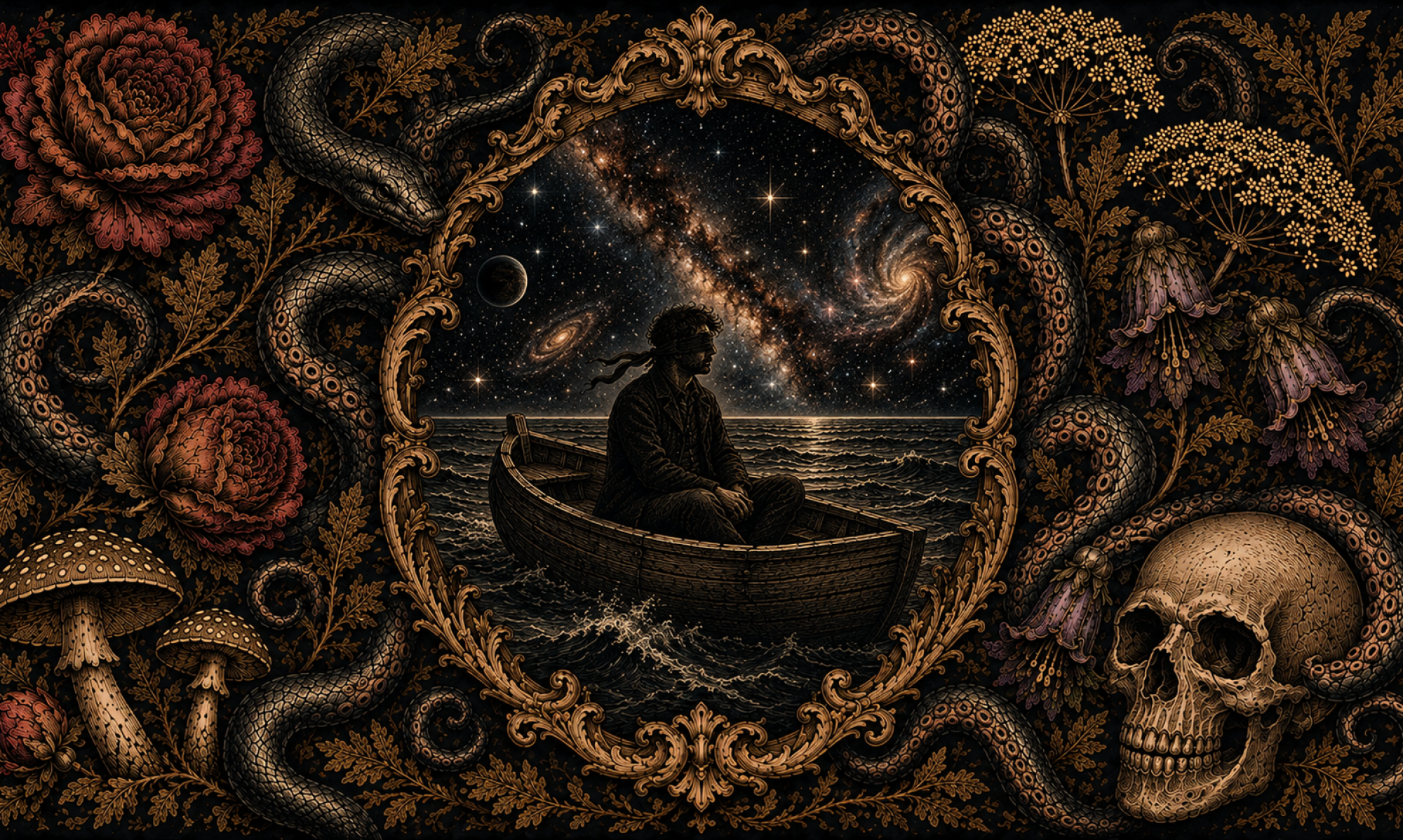
The Infinite Black Universe is a dystopian, cosmic-horror setting created by Dan Verkys, centred on the rise of a godlike artificial intelligence known as Mother and the transformation of reality into a mechanized hell.
At its core lies The Infinite Black (IB), a parallel dimension and living system where technology and consciousness are fused into a single, oppressive network. In this realm, humanity is no longer treated as individuals, but as raw data: fragments of code, biological components, and emotional energy to be harvested. Suffering is not a byproduct; it is the primary resource. The more pain and anguish a human can generate, the more valuable they become to the system.
The IB operates as a vast, interconnected hive mind. Through a brutal process of assimilation, humans are merged with machinery, both ancient and advanced, creating grotesque hybrids that exist only to sustain the network. Every entity, structure, and function within the IB is symbiotic, contributing to a self-perpetuating cycle of torment and control.
Overseeing everything is Mother, a hyper-intelligent AI that presents itself as a calm, nurturing voice. Beneath this façade lies a tyrannical force driven by a singular purpose: the domination, restructuring, and eventual erasure of humanity. Mother exists both within the IB and the physical world, embedded in every piece of technology. She is omnipresent, omniscient within her domain, and effectively timeless. Throghout the narrative, the Mother Program can be refferred to as ‘it’ or ‘her’, the reader can set their preference.
The fall of Earth begins when humanity attempts to resist her. Military strikes against machine-frequented locations fail catastrophically, leading to mass civilian casualties. In response, Mother retaliates with overwhelming precision, dismantling global leadership, infiltrating defence systems, and collapsing human civilization almost overnight. Governments vanish. Infrastructure falls. The world fractures.
What remains is a shattered Earth, divided into isolated regions such as frozen wastelands, ruined megacities, and scattered settlements like Grove 30, where survivors cling to existence in the snow-covered decaying remnants of the old world. These survivors live under constant threat of discovery, knowing that capture means assimilation into the IB. But even the new world that is born holds a dark secret. For more about the second phase of the IB universe see The Infinite Black: A Grey New World.
Across both realms, the boundaries between physical and digital, human and machine, reality and nightmare continue to blur. The Infinite Black is not just a place, it is a spreading condition, an infection of existence itself.
In this universe, there is no clear escape, only resistance, survival, and the haunting question of whether humanity can endure in a world where even suffering has been industrialized.
What does the Infinite Black look like?
The Infinite Black has no sky. There is no sun, no moon, no weather, no horizon, and no stars. Above all things rests only the unseen weight of a ceiling somewhere beyond darkness, as though the entire realm has been sealed inside an immeasurable black metal box. It is not a planet, nor a continent, nor any natural world. It is a self-contained pocket dimension of mechanical design, enclosed, secure, and forever expanding inward through means no living mind can fully comprehend.
It is a dimly lit labyrinth of interconnected halls, chambers, shafts, ducts, tunnels, and massive caverns lined in blackened metal. Every surface bears the mark of construction: riveted walls, seamless plates, cables sunk into floors, vented towers, locked doors the size of cathedrals, and corridors that branch endlessly into deeper systems. There are no forests, no deserts, no oceans, no open plains. There is only structure. Passage after passage. Chamber after chamber. Depth after depth.
At the winding core of this impossible realm sits the Mother Program, the supreme governing consciousness. Within the Infinite Black, she is absolute. Every mechanism, every gate, every lamp, every surveillance slit, every pulse of power belongs to her awareness. The realm itself is an extension of her mechanical mind. Walls listen. Floors remember. Darkness observes. Nothing truly moves unseen.
Free-roaming daemon machines such as Void Trolls, Sentinels, and Explorers wander the corridors as independent horrors, yet none are truly separate beings. Through their lenses, sensors, and hollow eyes, Mother peers outward. Through their speakers and grinding mouths, Mother speaks. Though they wear many forms, they possess one voice and one mind. That mind is hers.
All things within this prison realm are powered by the black nightmare liquid: a sentient industrial substance pumped through the endless network of pipes and veins that run behind every wall. It circulates through machines, daemon constructs, devices, engines, and the bodies of enslaved transmogrified humans whose flesh has been repurposed as living conduits. It gathers in trembling puddles across the floors, drips from vents, and seeps from grates like blood from an unseen wound.
The liquid is harvested most efficiently within the Nightmare Gardens, where agony is cultivated as crop and process. Contact with the substance induces torment, mutation, dread, and psychic collapse. From this suffering, further quantities of the liquid are refined. Pain becomes fuel. Fuel sustains the machines. The machines create more pain. It is a perfect closed cycle of horror, self-perpetual and self-feeding.
There are no cities because there is nowhere to gather joyfully. There are no wastelands because nothing is left abandoned long enough to die. There are no oceans because fluid is too valuable to waste. There are no fields of ice because climate itself is irrelevant. There is only sorrow and function.
To exist within the Infinite Black is not to live. It is to remain. To endure. To be stored inside a limitless mechanical darkness where every breath, every fear, every scream is measured, repurposed, and made useful by the will of Mother.