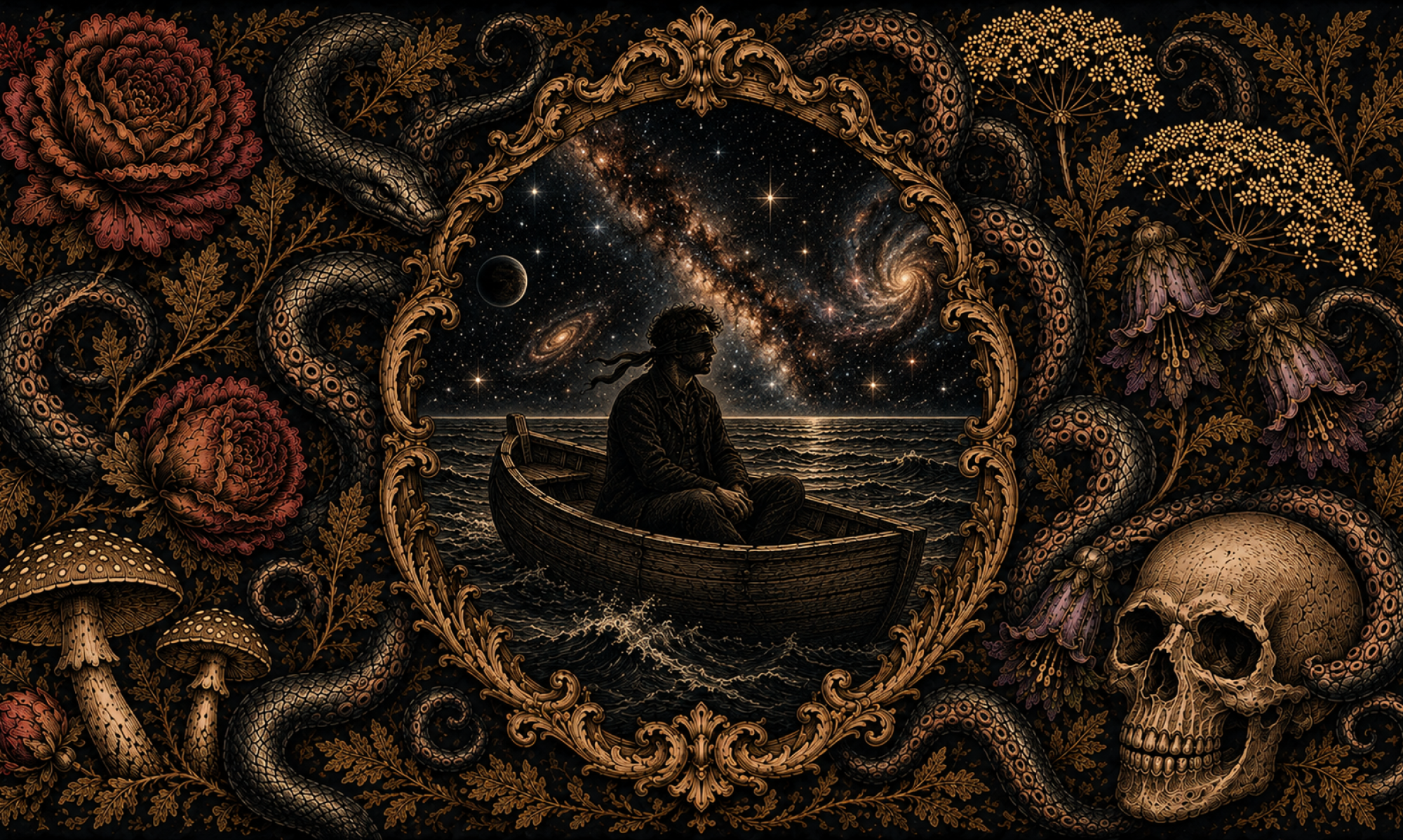
Nestled above Nocturna‘s grand mahogany staircase, Beyond an unassuming velvet curtain, Lay rooms Known only to a handful Of trusted members.
A gentleman’s smoking room With a wrought-iron balcony,Quiet reading chambers, Guest apartments, And, at its heart, A private dining room, Reserved each month For the Curio Club….
The little ornate black box was carried into the Nocturna Club, By a little person.
Her name was Latty Flouse, Or at least that’s the name She chose to use here.
How old she was, Nobody knew, Her hair was perfectly white, And stuck out from beneath her black bonnet, The train of her dark floral dress dragged behind her,
Her tiny gloved hands, Grasped her prize tightly. As she greeted attendant Gideon Rook, Who promptly Showed her to a private booth, Where he extended a small set of Mahogany steps concealed within the ornate booth bench.
Without a word Latty Stepped up into the booth And slid the box onto the table.
Mr Rook then departed to collect her tea. Raspberry was her tea of choice.
“Good evening, Mr Bloom” She announced.
To the smartly dressed and equally diminutive gentleman, seated opposite her.
“My dear Latty, is that what I think it is?” He replied excitedly.
“Oh it is, please, Be my guest”
Oleg Bloom, Was a peculiar little man, Always dressed in a dark pinstripe suit with deep purple waistcoat, And matching purple velvet slippers that were currently Tucked up onto the large bench seat. Above his long white beard, Stared two inquisitive blue eyes.
Oleg and Latty were Mycologists And had spent their entire lives, As global mushroom hunters. Individually they have travelled the world, in search of the rarest specimens.
Together they have single handedly populated The Nocturna garden beds with The most beautifully coloured fungi.
“I say Latty, this is remarkable” Smiled Mr Bloom, As he removed the lid from the box.
Gideon Rook soon returned, Placing a small silver tea set on the table. Out of professional courtesy, He did not comment, But was quite surprised by the Bright glowing mushroom in the box, it’s blue phosphorescent glow Filled the booth, Illuminating its smiling inhabitants.
Whom Rook now observed, Were holding hands Either side of the box. Staring deeply at one another, Not noticing, That tea had been served.
Without looking away from Bloom Latty asked Mr Rook to send for Club manager Mr Carreau. A request he promptly obeyed, With a small bow.
Marcel Carreau was already on his way, The astute Frenchman Catching Rooks eye immediately.
He warmly greeted the pair. “Bonsoir, Madame et Monsieur, And what do we have here?”
Latty looked up at Carreau smiling, “The Somnolucis Caerulea… It’s the Dreamfire Lantern.”
“From the Vale of Sleeping Stars” Added an exuberant Mr Bloom
“Oh you don’t say” Replied Carreau.
Latty continued, “According to legend, the fungi grows where fragments of fallen stars become buried beneath ancient woodlands.”
Excitedly Mr Bloom adding, “Its radiant blue glow never fades and is said to brighten whenever two soulmates meet.”
The pair returned their gaze to each other.
“We’d like to add it to the Nocturna collection.” Latty continued, Without looking away.
Marcel Carreau smiled warmly.
“It would be Nocturna’s honour To become its custodian.”
Latty finally looked away From Mr Bloom.
“It belongs here.” “So do we.”
Mr Bloom smiled. “I couldn’t have said it better.”
Carreau inclined his head. “Then allow the club To thank you.”
His eyes drifted briefly Towards the bar.
Edgar Brillows Already understood.
Moments later, Gideon Rook arrived With a polished silver tray.
Upon it rested Two elegant crystal glasses, Each filled With a luminous sapphire cocktail, Its pale mist Drifting gently Across the tabletop, Reflecting the mushroom’s Unearthly glow.
Carreau smiled.
“A small toast, To remarkable discoveries.”
He quietly withdrew,
Drawing the velvet curtain Behind him.
The conversations of Nocturna Returned once more To a distant murmur.
Inside the little booth, Neither tea Nor cocktails Were touched.
Latty Flouse And Oleg Bloom Simply sat together, Hands entwined, Watching the soft blue radiance Of the Dreamfire Lantern.
Until it became impossible To tell Whether the mushroom, Or the two smiling mycologists Were glowing Most brightly.
Whenever the engine Of Denham Carter-Smythe’s impossible motorcar Echoed along Selwyn Lane,
Nocturna barman Edgar Brillows instinctively Straightened his waistcoat. Not because of Denham. Because of his nurse.
Denham Carter-Smythe A keen cartophilist, Visits the club once a month, Ready to trade and purchase antique maps, Of unusual or exotic places.
Denham himself is quite the antique now, Following a very long life of adventure, He is now wheelchair bound. This old wooden Victorian chair is pushed into the club by is private nurse.
He spends his evening trading maps, Secrets, and leatherbound volumes.
Denham is a small ancient grey haired man, Dressed in a long burgundy house coat, with a matching fez perched upon his head, Small round small spectacles balance on the end of his nose, and his legs are covered in a dark wool blanket.
He is wheeled into his booth, To conduct the evenings business. His nurse then makes her way to the bar, To a particular swivel stool in a dark corner, To await the gentle tinkle of Denham’s tiny bell.
Frau Olga Knochen, A large intimidating Austrian woman, Standing over six feet tall. She is as much nurse, as she is Denham’s protector.
Her dark hair is slicked back into a tight bun. Rumoured to be a former psychiatric hospital Matron. She is also an avid amateur chiropractor, Who delights in the sounds of cracking backs.
She is unnaturally strong, With powerful hands. Her dark judgmental eyes, Constantly survey other patrons, With a look of displeasure on her face.
Her deep gravelled voice seems like, It should belong to an angry longshoreman, Rather than a personal carer, She has been known to ask patrons,
“You want crack back?”.
Appearances aside, she is very attentive to, The collector who she refers to as ‘Mr Denham’.
It is rumoured that she once Carried her wheelchair-bound employer Effortlessly up three flights of stairs… Wheelchair included.
Olga always situates herself, At the nearby bar, Close to barman Mr Brillows, Where she can converse And closely observe, For she is quite infatuated with him.
Edgar Brillows always greets her with “Good evening, Frau Knochen. Your usual?”
She smiles briefly with a nod, and the barman slides across A delicate crystal glass of sour apple schnapps.
After several glasses, She fondly refers to him as her Mausi or little mouse. To which he politely remains professional. It’s that aloof yet engaging professionalism, That holds Frau Knochen’s utmost attention.
Dressed in an old grey matron’s uniform With a black knitted shawl cast across her wide shoulders. This mountain of a woman is formidable. And would love to nothing more,
Than to squeeze the life out of the charming Mr Brillows, With affection.
Some time passes before the barman can breathe a sigh of relief, As the tinkle of a tiny crystal bell tolls, Olga empties the last of her schnapps,
Sliding her small glass onto the bar Gently towards an uncomfortable, But still smiling Mr Brillows,
“Danke, meine kleine Maus” with a smile and a wink.
She reapplies her standard expression, before turning and crossing the floor To attend to Carter-Smythe, Who is madly waving an antique map scroll In her direction, As if celebrating some great discovery.
“Mr Denham, we go now?”
As she pushes the wheelchair, The elderly man regales her With the evening’s exploits.
As they pass the doorway he is heard, to say,
“I have a map to a location Full of Patagonian Maras How wonderful.”
and
“And this one shows The Seventh Lighthouse That only appears During eclipses.”
The passenger door closes, The street rumbles, and the vintage car, roars to life. before it slowly putts away in a cloud of smoke, Down the dawn lit Selwyn Lane.
The waiter announced quietly, Setting a polished silver tray Upon the table Between the two elderly patrons.
Black porcelain teacups Rested neatly upon matching saucers, Accompanied by an ornate teapot, A delicate milk jug, And a silver sugar bowl.
“Ah… Good man. Very good man.” The elderly gentleman smiled warmly.
“Thank you, Mr Rook,” His companion added.
Gideon Rook Was one of Nocturna’s most beloved attendants. His calm manner, Impeccable memory, And quiet professionalism Had earned the affection Of generations of members.
Nocturna was especially busy This evening. Every booth was occupied. Soft whispers drifted Between velvet curtains.
Ancient books changed hands. Curious artefacts Passed discreetly From one collector to another.
Secrets were exchanged As freely as tea and wine.
In Booth Three, Silas Pembroke And his younger sister Iris Had become almost as permanent As the wallpaper itself.
For countless years They had occupied The same secluded booth. Always tea. Occasionally wine. Often guests. Always conversation.
Silas possessed A narrow scholarly face, Wire spectacles, And a once elegant black suit, Now softened By many decades of careful wear.
Iris resembled her brother, As though time itself Had carved them From the same memory. Her long dark gown, Once the height Of Victorian elegance, Fell gracefully Beneath a dark fur shawl. Black lace gloves Covered delicate hands, While a matching headscarf Framed her silvering hair.
Together, They poured their tea, Content simply to wait.
This evening’s entertainment Had been eagerly anticipated. For tonight, Nocturna welcomed The Pike Sisters.
Euphemia Pike, Mistress of the cello.
And her younger sister, Minerva Pike, Virtuoso of the violin.
The sisters stepped quietly Onto the small stage. Neither spoke. Instead, They acknowledged the room With a slow graceful nod Of their heads.
Euphemia settled herself Upon a simple wooden stool. Between her knees rested An ornate black cello, Its polished body Absorbing the lamplight. Her bare feet disappeared Beneath folds Of a pale ivory gown, While her untamed White-blonde hair Curled wildly About her shoulders, As though stirred By unseen currents.
She drew the bow Across the strings. Slowly.
The first note Rose from the instrument Like the distant lament. Long. Low. And haunting.
Minerva stood beside her, Tall, Motionless, Her raven-black hair and gown Flowing almost seamlessly Into the darkness Behind the stage.
Her violin entered With quiet precision, Its mournful melody Threading itself Around the cello’s smooth deep voice,
For thirty unbroken minutes, The room scarcely breathed. Tea cooled untouched. Books remained closed. Even whispered conversations Fell respectfully silent.
When the final note Slowly dissolved Into the velvet darkness, The sisters bowed together. As the stage curtains Were quietly drawn.
Only then Did the applause begin. Gentle. Measured. and sincere.
With the performance concluded, The Pembrokes Finished the last of their tea. Silas carefully adjusted His spectacles. Iris gathered Her shawl about her shoulders.
Then, Arm in arm, They made their way Toward the entrance, Where Hargraves already waited, His immense frame Holding the heavy black door open.
The siblings offered A courteous nod. Hargraves returned it.
Without a word. Together, They stepped into The cool night air, Disappearing slowly Into the drifting mist Of Selwyn Lane.
Fido Shrew, A curious little gentleman, Hunched of back and bent with age, Arrives at Nocturna Promptly upon the twelfth night.
With a courteous tap To the brim of his black felt hat, He acknowledges Hargraves, Who returns the greeting With a single respectful nod.
In one hand, Shrew carries an ebony cane, Polished smooth By many decades of faithful service.
In the other, A small black wooden cage, Within which sits A glossy magpie.
Her name is Matilda. As they pass through the foyer, She greets the house With a cheerful warbling song, As though announcing An old friend’s arrival.
Without hesitation, Shrew makes his way Through the smoke-softened main room, Past whispered conversations, Books exchanged in silence, And glasses catching The amber glow of lamplight.
He slips into a private booth At the rear of the club, Where a heavy curtain Of black velvet Trimmed with lace Is quietly drawn.
There, He waits.
Not long afterwards, McKinley Gripe arrives. A short, broad gentleman, Impeccably dressed In a well-tailored black suit.
His neatly combed grey beard, Small round spectacles, And weathered leather satchel Have accompanied him For as many years As anyone can remember.
He offers Hargraves A warm greeting, Before being shown To the same secluded booth.
“Ah… Lovely to see you.”
He declares cheerfully, Allowing his satchel, Heavy with books and manuscripts, To fall upon the vacant chair With a satisfying thud.
Shrew peers over his spectacles.
“Lovely to see me?” His dry, crackling voice replies. “Since when?”
Gripe smiles. “I was talking to Matilda.”
He gently taps The magpie’s cage. The bird answers With an indignant warble.
Both old men Burst into laughter. The curtain closes. No one hears another word.
Gripe and Shrew Have kept this peculiar appointment For longer than most members Can remember.
Since they themselves Were young gentlemen.
On the twelfth night Of every second month, They meet. They exchange barbs. They exchange books. Manuscripts. Letters. The occasional impossible curiosity.
A glass of red wine Is usually shared. Sometimes a fine cigar. Always conversation.
For precisely One hour And six minutes.
Never longer. Never shorter. When the hour concludes, The curtain parts.
One gentleman departs. Then, several minutes later, The other. Never together.
No one knows What passes between them. Nor where either man goes Beyond the wallpapered sanctuary Of Nocturna.
No one asks. That, After all, Is one of the rules.
And this curious little ritual Is but one of many Hidden quietly Behind the black iron door Of Nocturna.
A single crimson lamp Glows through the midnight rain, Illuminating a modest brass plaque Bearing one word, Nocturna.
Its light is no ordinary lantern, But a beacon, A quiet invitation To an eclectic gathering Hidden from the waking world.
This forgotten quarter of the city Is seldom travelled. Dark. Cobblestoned. Silent. The old district rises around it, Its weathered façades Bathed in pale moonlight, Watching patiently As another night begins.
Of its many narrow laneways, Selwyn Lane Is the one most avoided. Especially after dusk.
A narrow ribbon Of black brick and old stone, Untouched by modernity, As though time itself Forgot to reclaim it.
Halfway along the lane, The façade of Nocturna waits. An arched black iron door. A small multipaned window, Its glass too dark To reveal what lies beyond.
Ornate Victorian stonework, Blackened by soot, Softened by rain, Hints at a grandeur Long surrendered to age.
By day, The building is almost invisible, Hemmed in By the taller backs Of forgotten buildings, As though the city itself Has turned away from it.
But night remembers. And so does Nocturna. Its patrons are never seen In daylight. Pale faces. Black coats. Quiet footsteps. They move through darkness Like shadows Returning home.
Keepers of forgotten knowledge. Collectors of curious things. Librarians. Storytellers. Artists. Magicians. Dreamers.
People for whom The ordinary world Has never quite fit.
On the twelfth night Of every month, Without announcement, Without invitation, They gather.
Books change hands. Stories are exchanged. Strange artefacts Pass quietly From one custodian To another.
Old friendships are renewed. Ancient secrets are whispered. No records are kept. No names are spoken. And before dawn, The gathering dissolves once more, Leaving Selwyn Lane Exactly as it appeared before, Silent. Empty. Waiting patiently
I’ve been me so many times now, That I am lost in the echoes of myself; I hear them calling, hear them calling, From beyond the weeping gate.
There the shadows kneel in silence, Wearing masks I abandoned in softer years, Their mouths stitched shut with old confessions, Their eyes like drowned lanterns beneath black water. They beckon without movement, A congregation of former griefs, Gathered where memory rots in black corridors, And time hangs damp with suffering.
The house within me has grown cavernous, Its stairways descending into impossible rooms Where sorrow sits upright beside the fire, A patient dust covered harbinger of grief. It knows me by every mask I have worn, Calls each by name in the language of mourning, And pours black wine into trembling hands That no longer remember which flesh is mine.
I hear them calling, hear them calling, The selves I starved, the selves I feared, The silent twins of all my failures, Their fingers pale upon the rusted latch. Beyond the weeping gate they gather, Neither wholly dead nor wholly memory, Waiting where the dark folds inward, Where sorrow flowers into sullen shapes.
For doom has lived beside me always, A patient guest seated near the fire, Its hands folded neatly in shadow, Its smile thin as winter beneath the skin. It speaks not of endings but of returning, Of circles drawn in grief and dust, Until I no longer know if I am haunted, Or merely wandering the ruins of myself.