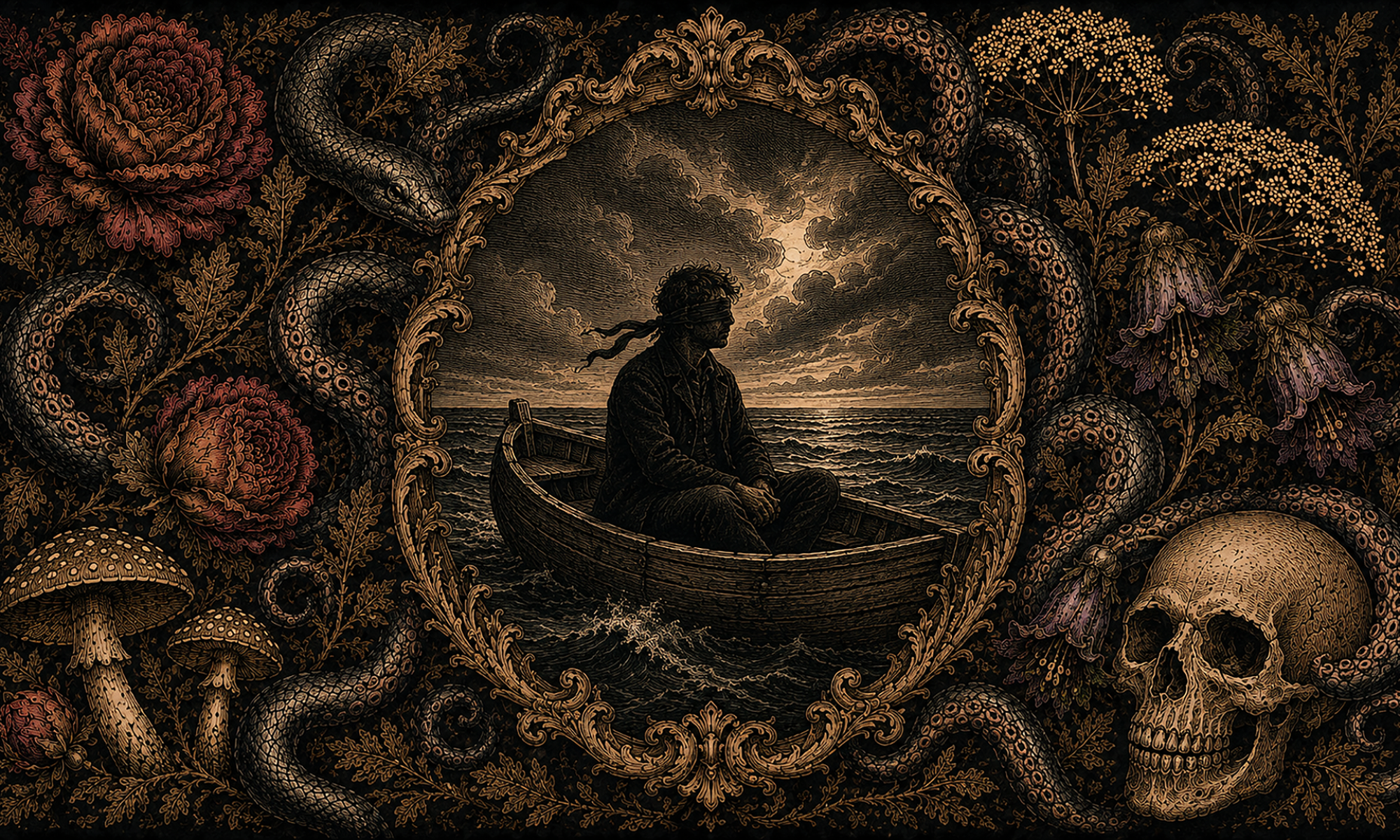
Time, And the restless city, Forgot old Selwyn Lane.
Its weathered buildings, Once alive with commerce, Slowly emptied.
Doors closed. Windows gathered dust. One by one, Their occupants Simply went elsewhere.
Although some remain empty To this day, All quietly found New custodians.
Purchased, Not by developers, Nor speculators, But by club members Of Nocturna.
Many gifted their buildings To the club itself, Allowing the sanctuary To grow Patiently, Silently, One adjoining wall at a time.
Behind ancient brickwork, Doorways became archways. Storerooms became libraries. Warehouses became museums. Forgotten offices Became quiet reading rooms, Cabinets of curiosities, Map vaults, Conservatories, Trade halls, And discreet apartments Reserved for distinguished guests.
To the city, The block still appeared Forgotten.
Weathered. Half abandoned. But appearances Have always been deceiving When it comes to Nocturna.
Within those old walls, Life quietly flourished. Books found readers. Collectors found discoveries. Artists found inspiration. Friends found one another.
And every twelfth night, of the month, The sanctuary grew A little richer.
Nocturna is no longer Merely a private club. For many, It has become A way of life.
An entire city block, Quietly devoted to curiosity, Craftsmanship, Scholarship, Wonder, And the preservation Of beautiful impossibilities.
Three times yearly, When the moon reaches an agreeable position, The members gathered Before the great carved oak doors That separated The warmth of Nocturna From its hidden courtyard.
The lanterns burned softly. Perfume drifted beneath the ancient arches. Someone coughed politely. Someone else Had already begun drinking…
The little ornate black box was carried into the Nocturna Club, By a little person.
Her name was Latty Flouse, Or at least that’s the name She chose to use here.
How old she was, Nobody knew, Her hair was perfectly white, And stuck out from beneath her black bonnet, The train of her dark floral dress dragged behind her,
Her tiny gloved hands, Grasped her prize tightly. As she greeted attendant Gideon Rook, Who promptly Showed her to a private booth, Where he extended a small set of Mahogany steps concealed within the ornate booth bench.
Without a word Latty Stepped up into the booth And slid the box onto the table.
Mr Rook then departed to collect her tea. Raspberry was her tea of choice.
“Good evening, Mr Bloom” She announced.
To the smartly dressed and equally diminutive gentleman, seated opposite her.
“My dear Latty, is that what I think it is?” He replied excitedly.
“Oh it is, please, Be my guest”
Oleg Bloom, Was a peculiar little man, Always dressed in a dark pinstripe suit with deep purple waistcoat, And matching purple velvet slippers that were currently Tucked up onto the large bench seat. Above his long white beard, Stared two inquisitive blue eyes.
Oleg and Latty were Mycologists And had spent their entire lives, As global mushroom hunters. Individually they have travelled the world, in search of the rarest specimens.
Together they have single handedly populated The Nocturna garden beds with The most beautifully coloured fungi.
“I say Latty, this is remarkable” Smiled Mr Bloom, As he removed the lid from the box.
Gideon Rook soon returned, Placing a small silver tea set on the table. Out of professional courtesy, He did not comment, But was quite surprised by the Bright glowing mushroom in the box, it’s blue phosphorescent glow Filled the booth, Illuminating its smiling inhabitants.
Whom Rook now observed, Were holding hands Either side of the box. Staring deeply at one another, Not noticing, That tea had been served.
Without looking away from Bloom Latty asked Mr Rook to send for Club manager Mr Carreau. A request he promptly obeyed, With a small bow.
Marcel Carreau was already on his way, The astute Frenchman Catching Rooks eye immediately.
He warmly greeted the pair. “Bonsoir, Madame et Monsieur, And what do we have here?”
Latty looked up at Carreau smiling, “The Somnolucis Caerulea… It’s the Dreamfire Lantern.”
“From the Vale of Sleeping Stars” Added an exuberant Mr Bloom
“Oh you don’t say” Replied Carreau.
Latty continued, “According to legend, the fungi grows where fragments of fallen stars become buried beneath ancient woodlands.”
Excitedly Mr Bloom adding, “Its radiant blue glow never fades and is said to brighten whenever two soulmates meet.”
The pair returned their gaze to each other.
“We’d like to add it to the Nocturna collection.” Latty continued, Without looking away.
Marcel Carreau smiled warmly.
“It would be Nocturna’s honour To become its custodian.”
Latty finally looked away From Mr Bloom.
“It belongs here.” “So do we.”
Mr Bloom smiled. “I couldn’t have said it better.”
Carreau inclined his head. “Then allow the club To thank you.”
His eyes drifted briefly Towards the bar.
Edgar Brillows Already understood.
Moments later, Gideon Rook arrived With a polished silver tray.
Upon it rested Two elegant crystal glasses, Each filled With a luminous sapphire cocktail, Its pale mist Drifting gently Across the tabletop, Reflecting the mushroom’s Unearthly glow.
Carreau smiled.
“A small toast, To remarkable discoveries.”
He quietly withdrew,
Drawing the velvet curtain Behind him.
The conversations of Nocturna Returned once more To a distant murmur.
Inside the little booth, Neither tea Nor cocktails Were touched.
Latty Flouse And Oleg Bloom Simply sat together, Hands entwined, Watching the soft blue radiance Of the Dreamfire Lantern.
Until it became impossible To tell Whether the mushroom, Or the two smiling mycologists Were glowing Most brightly.
Edgar Brillows is a craftsman, Not of wood or stone, But of cocktails.
A creator of merriment, His crystal creations Smoked, Sparkled, Changed colour, Or bloomed Like flowers Within the glass.
A slight man with greying blonde wavy hair, Brillows maintains Impeccable grooming And immaculate attire.
Wearing a short Van Dyke beard And neatly trimmed moustache, An ivory waistcoat Embroidered with silver thread, A polished silver pocket watch, A tailored black suit, And a crisp white apron.
Attire aside, it is his professional skills That really set him apart from others, Personally memorising countless exotic recipes, Discovered from all over the world.
He has many admirers, Most of all club regular Frau Knochen. Nocturna Manager Marcel Carreau is always amazed, At Brillow’s incredible talent, His skill commands The respect it receives.
This evening, Leaning flirtatiously with one arm On the bar is Lenore Morrow, Twin sister of Leon Morrow.
The siblings are this month’s entertainment, A musical double act known as Leon & Lenore.
It seems Lenore has taken quite a liking to Brillows.
Carreau watches from his booth, Smiles and shakes his head.
“Remarkable… He has no idea. Poor Monsieur Brillows.”
The Frenchman chuckles to himself.
“He should be thankful Monsieur Carter-Smythe Isn’t attending this evening With Frau Knochen”
Leon Morrow is young, handsome, and brash, As is his twin. Both siblings have very long straight hair As black as night.
Both are porcelain skinned, and dressed in exquisite black attire. Leon’s tailored suit is an exotic three piece, Lenore’s gown is flowing and glistens with a hint of tiny gemstones.
Leon is a skilled pianist, Lenore, an accomplished vocalist.
They take the stage and thank the audience, As Leon prepares himself at his glossy black piano, The lovely Lenore blows a kiss to a somewhat embarrassed Mr Brillows, Who respectfully bows in return.
For precisely Thirty minutes, The duo performed.
And bow to the stage as the curtains draw.
They appear amongst the crowd soon after, Carreau shaking hands and pecking cheeks.
Before the crowd gathers around them, Mr Brillows appears with a silver tray, Containing two tall crystal glasses Filled with a mysterious purple elixir, which releases a white fog As though dry ice Had been added.
With a bow he returns to the bar, Under the watchful eye and smiling face Of a delighted Ms Morrow.
The evening slowly settled Into its familiar rhythm.
Laughter drifted. Secrets were whispered. Old friends embraced. New acquaintances were made. Books changed hands. Artefacts found new custodians. Glasses were emptied, Then quietly refilled.
From his place behind the bar, Edgar Brillows saw everything.
Who sat with whom. Who arrived together Who left alone. Who laughed the loudest. Who cried the hardest. Who argued. Who quietly purchased impossible curiosities, Before disappearing into the mist. Who lingered Long after everyone else. Who quietly said goodbye. Who never returned.
Yet never once Did he repeat a single word.
Stepping behind the bar beside Brillows, Marcel Carreau smiled knowingly. “You know everything, Don’t you, Monsieur Brillows?”
The barman paused, Polishing the rim of a crystal glass.
A faint smile touched his face.
“No, Monsieur. I know only What people choose to leave behind In empty glasses.”
Carreau laughed softly and returned to his position.
“The glass always remembers.” He whispered to himself.
The music resumed.
Conversation drifted once more Through velvet booths And candlelight.
Outside, Rain washed The cobblestones Of Selwyn Lane.
Inside, Edgar Brillows Quietly polished another crystal glass, As though Nothing remarkable Had happened at all.
For that was the peculiar burden Of a good barman.
The courtyard garden Of Nocturna Lies hidden At the heart of the club.
It is no ordinary courtyard. There is no open sky.
Instead, An immense glass ceiling Spans the space above, Filtering the moonlight Into a soft Silvery glow.
The night sky Feels close enough To touch, Yet remains Beyond the glass.
Ancient stone paths Wind quietly Between raised beds Filled with rare herbs, Curious flowers, And exotic plants Collected by club members from distant lands.
Some bloom only By moonlight. Others perfume the air With fragrances Unknown beyond these walls.
Members wander slowly, Teacup, Book, Or notebook in hand, Finding quiet corners In which to think, Read, Or simply listen To the gentle movement Of leaves Beneath the moonlit glass.
It is said That no plant Within Nocturna’s garden Has ever truly died.
Only waited patiently For the right season To bloom again.
Whenever the engine Of Denham Carter-Smythe’s impossible motorcar Echoed along Selwyn Lane,
Nocturna barman Edgar Brillows instinctively Straightened his waistcoat. Not because of Denham. Because of his nurse.
Denham Carter-Smythe A keen cartophilist, Visits the club once a month, Ready to trade and purchase antique maps, Of unusual or exotic places.
Denham himself is quite the antique now, Following a very long life of adventure, He is now wheelchair bound. This old wooden Victorian chair is pushed into the club by is private nurse.
He spends his evening trading maps, Secrets, and leatherbound volumes.
Denham is a small ancient grey haired man, Dressed in a long burgundy house coat, with a matching fez perched upon his head, Small round small spectacles balance on the end of his nose, and his legs are covered in a dark wool blanket.
He is wheeled into his booth, To conduct the evenings business. His nurse then makes her way to the bar, To a particular swivel stool in a dark corner, To await the gentle tinkle of Denham’s tiny bell.
Frau Olga Knochen, A large intimidating Austrian woman, Standing over six feet tall. She is as much nurse, as she is Denham’s protector.
Her dark hair is slicked back into a tight bun. Rumoured to be a former psychiatric hospital Matron. She is also an avid amateur chiropractor, Who delights in the sounds of cracking backs.
She is unnaturally strong, With powerful hands. Her dark judgmental eyes, Constantly survey other patrons, With a look of displeasure on her face.
Her deep gravelled voice seems like, It should belong to an angry longshoreman, Rather than a personal carer, She has been known to ask patrons,
“You want crack back?”.
Appearances aside, she is very attentive to, The collector who she refers to as ‘Mr Denham’.
It is rumoured that she once Carried her wheelchair-bound employer Effortlessly up three flights of stairs… Wheelchair included.
Olga always situates herself, At the nearby bar, Close to barman Mr Brillows, Where she can converse And closely observe, For she is quite infatuated with him.
Edgar Brillows always greets her with “Good evening, Frau Knochen. Your usual?”
She smiles briefly with a nod, and the barman slides across A delicate crystal glass of sour apple schnapps.
After several glasses, She fondly refers to him as her Mausi or little mouse. To which he politely remains professional. It’s that aloof yet engaging professionalism, That holds Frau Knochen’s utmost attention.
Dressed in an old grey matron’s uniform With a black knitted shawl cast across her wide shoulders. This mountain of a woman is formidable. And would love to nothing more,
Than to squeeze the life out of the charming Mr Brillows, With affection.
Some time passes before the barman can breathe a sigh of relief, As the tinkle of a tiny crystal bell tolls, Olga empties the last of her schnapps,
Sliding her small glass onto the bar Gently towards an uncomfortable, But still smiling Mr Brillows,
“Danke, meine kleine Maus” with a smile and a wink.
She reapplies her standard expression, before turning and crossing the floor To attend to Carter-Smythe, Who is madly waving an antique map scroll In her direction, As if celebrating some great discovery.
“Mr Denham, we go now?”
As she pushes the wheelchair, The elderly man regales her With the evening’s exploits.
As they pass the doorway he is heard, to say,
“I have a map to a location Full of Patagonian Maras How wonderful.”
and
“And this one shows The Seventh Lighthouse That only appears During eclipses.”
The passenger door closes, The street rumbles, and the vintage car, roars to life. before it slowly putts away in a cloud of smoke, Down the dawn lit Selwyn Lane.
On the twelfth night, When crimson lamplight Burned quietly Against the rain, And Selwyn Lane Remembered What daylight always forgot, A familiar figure Came stumbling Out of the mist.
Not quietly. Never quietly. His stained safari trench coat Hung from narrow shoulders Like a weather-beaten tent.
A battered pith helmet Sat defiantly Upon a head That had spent Far too many years Arguing with jungles.
Whether trousers Lay beneath the coat, No soul Could honestly say.
Only long beige socks, Mud-caked gaiters, And great brown hiking boots Introduced themselves To the cobblestones.
Across his chest Hung a worn leather satchel, Heavy with impossible things.
A feathered serpent No larger than a sparrow. A taxidermied rodent Bearing six glass eyes. A butterfly With transparent wings That refused To collect dust.
His silver hip flask Appeared Every few minutes. Its curious contents Smelled faintly Of formaldehyde, Mentholated spirits, And regrettable decisions.
He swallowed deeply. Smiled. Then announced To nobody in particular,
“They’re close tonight.” “WHAT?”
The shout echoed Along Selwyn Lane, Disturbing only rainwater.
Daniel Hargraves, Watching from his velvet alcove, Did not flinch.
He simply inclined his head.
“Good evening, Mr Marcus-Walker.”
The old explorer Studied him suspiciously.
“You’ve not seen The Moustached Guenons, Have you?”
A pause.
“They’ve become Exceptionally organised.”
Another pause.
“They’ve formed committees.”
Hargraves merely opened The heavy black door.
“Welcome to Nocturna. May your stay Be a pleasant one.”
“They are also imaginary.” The bemused doorman responded
“So are taxes.” “WHAT?” He shouted as he wandered inside.
The library welcomed him As it always had. Books changed hands. Secrets travelled softly. Collectors gathered Around velvet tables, Examining impossible curiosities By candlelight.
Marcus-Walker Produced his latest treasure.
“A melancholy mongoose Discovered Near the upper Congo. Notice The expression.”
The assembled members Examined it With scholarly seriousness.
One offered A first edition.
Another, An ivory sextant.
A third, A bottle Containing rainwater Collected During an eclipse.
The bargain Was concluded With solemn nods.
“WHAT?” Marcus-Walker shouted suddenly.
Nobody reacted. Everyone had grown accustomed To the interruption, Like an old clock Striking At entirely the wrong hour.
From somewhere nearby Came the unmistakable sound Of an entirely deliberate Explosion of flatulence.
Marcus-Walker Turned furiously Towards an empty chair.
“There!” He cried.
“I warned you! The Guenons Have followed me again.”
Several members Looked politely At the vacant seat.
One even frowned, As though The invisible monkeys Had committed A genuine breach Of etiquette.
Edgar Brillows Placed a fresh glass Before the old traveller.
“I trust Your treehouse Remains secure?”
Marcus-Walker nodded gravely.
“Twenty-six feet above ground.”
“The alligators?” the barman offered
“Ah ha! powerless.” Henley replied,
“And the Guenons?” Brillows continued,
“They’ve mastered the bloody ladders.”
Brillows Considered this carefully. “Disturbing.”
“Profoundly.” Marcus-Walker laughed.
Not a chuckle. Not a smile. But a roaring, Wild, Untamed eruption That rolled through Nocturna Like jungle thunder, Leaving every candle Momentarily uncertain Whether to continue burning.
Then, Without warning, Marcus-Walker Spotted An elegant figure Crossing the foyer.
Tall. Broad shouldered. Impeccably dressed In black.
“My dear lady!” He declared, Removing his pith helmet.
“Might I interest you In supper At my treehouse, Followed by…breakfast?”
The room Became Exceptionally quiet.
Daniel Hargraves Slowly turned. Marcus-Walker Peered more closely.
“WHAT?” A silence.
Then another. “My profound apologies.”
Hargraves sighed, The sigh Of a man Repeating A familiar ritual.
Once again, He escorted The distinguished explorer Towards the entrance, One enormous hand Resting gently Upon his shoulder.
Marcus-Walker Accepted his fate With surprising dignity.
“Those damn Guenons Set me up.”
“I’ve no doubt.” Hargraves smiled
“They’re awfully vindictive creatures.” Marcus-Walker was becoming disorientated,
“So I’ve heard sir.” Hargrave replied politely.
Outside, The rain Had begun again.
The crimson lamp Burned steadily, Watching the old eccentric Disappear Into the sleeping city, Laughing wildly, Arguing With invisible monkeys, Pausing Every hundred yards To shout, With absolute conviction,
The two older gentlemen sat together, Clad in velvet smoking jackets, Their pipes sketching wild flourishes Through the candlelit air As though conducting An invisible orchestra.
No subject was ever considered too peculiar. The phases of forgotten moons. The etiquette of ghosts. Perfumes bottled from thunderstorms. The proper attire for melancholic ravens. Dreams that refused to belong To the dreamer who dreamt them.
Outside, Moonlight silvered the garden. Inside, Candles painted warm gold Across polished timber, Crystal and brass.
A great, black-framed bay window, Overlooking Nocturna’s private exotic garden, Had long ago become The exclusive preserve Of Mr Draker and Mr Ververs.
Once each month, Without fail, They occupied these armchairs For the entire evening.
They would speak for hours, Their conversations wandering Like old forest paths, Interrupted only by bursts Of irrepressible laughter.
Whenever their teacups emptied, They summoned Mr Rook, Who appeared with quiet precision, Bearing fragrant teas, Fine spirits, Or whatever curious refreshment The evening happened to require.
Seamus Draker wore colour With unapologetic enthusiasm.
His dark hair was cropped short, His blue velvet smoking jacket immaculate, His slippers embroidered With his own monogram, His white shirt crowned By a paisley blue cravat.
His eyes possessed The rare gift Of smiling before His mouth ever did.
Dante Ververs Was fashioned from darker cloth.
Black from collar to cuff, Broken only by A discreet grey polka-dot pattern Upon his collar.
Brow rimmed spectacles sat, Above his curled silver moustache And neatly pointed chin beard Which rarely remained still, For laughter constantly persuaded it Into motion.
Throughout the evening, Mr Draker would occasionally Drop a tiny morsel Onto a small silver plate Resting beside his chair.
Moments later, A black nose Would emerge cautiously From beneath the heavy tablecloth.
A morsel vanished.
Then so too Did its mysterious recipient.
No member of Nocturna Could confidently say What breed The tiny brown dog belonged to.
Nor did anyone know Its proper name. Mr Draker addressed the little creature Only with “bella dolce”.
As with many things Within Nocturna, No one thought it wise To ask why.
This evening’s discussion Concerned an exceedingly delicate matter.
Whether abandoned umbrellas, Left to weather beneath cemetery trees, Eventually forgot The names of the people Who had once carried them.
Mr Draker maintained That every umbrella retained The final conversation It had overheard before being abandoned, And that, during sufficiently heavy rain, One might still hear whispers Escaping between their ribs.
Mr Ververs disagreed entirely. He insisted That forgotten umbrellas Did not remember voices at all, But instead became Custodians of misplaced coincidences.
Lose one beside a grave, He argued, And somewhere else in the world A stranger would suddenly remember A birthday That had never truly happened.
The debate continued With extraordinary seriousness. Notes were taken. Diagrams were sketched in pocketbooks.
Three impossible theories Were proposed, One carefully withdrawn, And another unanimously condemned As being “Entirely too sensible.”
At last, The candles had shortened, The pipes had cooled, And the garden beyond the glass Had surrendered itself To the final hours before dawn.
The two old gentlemen rose together, Smiled warmly, And embraced With the familiarity Of cousins Who had shared A lifetime of impossible conversations.
Their hats were collected. Their coats buttoned.
Outside, Two polished black carriages Waited patiently At the kerb.
Mr Draker climbed into one. Mr Ververs into the other.
With a final exchange Of cheerful waves And promises To continue the argument Next month,
The carriages departed, Rolling into the sleeping city, Each disappearing In opposite directions,
Leaving only the fading sound Of horses upon wet cobblestones, And one unanswered question,
I’m delighted to share that The Valley of Ashes is finally complete.
I’m currently waiting on the production proof before announcing its official release, but I’m looking forward to making it available very soon for anyone who may be interested.
Working on two books throughout 2026 while continuing to explore other creative projects has been both exciting and incredibly rewarding, although it has certainly kept me busy. Completing The Valley of Ashes also brings closure to a creative journey that began back in 2020.
The project was born during the pandemic lockdowns, a time of deep introspection and reflection. What first emerged as a series of digital artworks, later inspired an ambient music album, and has now reached its final form as a book of long-form narrative poetry. Seeing the entire journey come full circle has been immensely satisfying.
I hope you’ll enjoy spending time in the Valley. Alongside the poetry, the book features a collection of antique-inspired illustrations that help bring its world to life, and I’m eagerly awaiting the chance to hold the finished copy in my hands.
As always, for those who regularly visit my website, much of the book’s content can already be explored on the Valley of Ashes world-building page.
Finally, thank you to everyone who has followed this journey over the years, whether through my former social media platforms or here on my website. This has been a deeply personal project, and your encouragement, kind words, and continued support have meant more to me than I can express.
The waiter announced quietly, Setting a polished silver tray Upon the table Between the two elderly patrons.
Black porcelain teacups Rested neatly upon matching saucers, Accompanied by an ornate teapot, A delicate milk jug, And a silver sugar bowl.
“Ah… Good man. Very good man.” The elderly gentleman smiled warmly.
“Thank you, Mr Rook,” His companion added.
Gideon Rook Was one of Nocturna’s most beloved attendants. His calm manner, Impeccable memory, And quiet professionalism Had earned the affection Of generations of members.
Nocturna was especially busy This evening. Every booth was occupied. Soft whispers drifted Between velvet curtains.
Ancient books changed hands. Curious artefacts Passed discreetly From one collector to another.
Secrets were exchanged As freely as tea and wine.
In Booth Three, Silas Pembroke And his younger sister Iris Had become almost as permanent As the wallpaper itself.
For countless years They had occupied The same secluded booth. Always tea. Occasionally wine. Often guests. Always conversation.
Silas possessed A narrow scholarly face, Wire spectacles, And a once elegant black suit, Now softened By many decades of careful wear.
Iris resembled her brother, As though time itself Had carved them From the same memory. Her long dark gown, Once the height Of Victorian elegance, Fell gracefully Beneath a dark fur shawl. Black lace gloves Covered delicate hands, While a matching headscarf Framed her silvering hair.
Together, They poured their tea, Content simply to wait.
This evening’s entertainment Had been eagerly anticipated. For tonight, Nocturna welcomed The Pike Sisters.
Euphemia Pike, Mistress of the cello.
And her younger sister, Minerva Pike, Virtuoso of the violin.
The sisters stepped quietly Onto the small stage. Neither spoke. Instead, They acknowledged the room With a slow graceful nod Of their heads.
Euphemia settled herself Upon a simple wooden stool. Between her knees rested An ornate black cello, Its polished body Absorbing the lamplight. Her bare feet disappeared Beneath folds Of a pale ivory gown, While her untamed White-blonde hair Curled wildly About her shoulders, As though stirred By unseen currents.
She drew the bow Across the strings. Slowly.
The first note Rose from the instrument Like the distant lament. Long. Low. And haunting.
Minerva stood beside her, Tall, Motionless, Her raven-black hair and gown Flowing almost seamlessly Into the darkness Behind the stage.
Her violin entered With quiet precision, Its mournful melody Threading itself Around the cello’s smooth deep voice,
For thirty unbroken minutes, The room scarcely breathed. Tea cooled untouched. Books remained closed. Even whispered conversations Fell respectfully silent.
When the final note Slowly dissolved Into the velvet darkness, The sisters bowed together. As the stage curtains Were quietly drawn.
Only then Did the applause begin. Gentle. Measured. and sincere.
With the performance concluded, The Pembrokes Finished the last of their tea. Silas carefully adjusted His spectacles. Iris gathered Her shawl about her shoulders.
Then, Arm in arm, They made their way Toward the entrance, Where Hargraves already waited, His immense frame Holding the heavy black door open.
The siblings offered A courteous nod. Hargraves returned it.
Without a word. Together, They stepped into The cool night air, Disappearing slowly Into the drifting mist Of Selwyn Lane.