Gripe and Shrew

Fido Shrew,
A curious little gentleman,
Hunched of back and bent with age,
Arrives at Nocturna
Promptly upon the twelfth night.

With a courteous tap
To the brim of his black felt hat,
He acknowledges Hargraves,
Who returns the greeting
With a single respectful nod.

In one hand,
Shrew carries an ebony cane,
Polished smooth
By many decades of faithful service.

In the other,
A small black wooden cage,
Within which sits
A glossy magpie.

Her name is Matilda.
As they pass through the foyer,
She greets the house
With a cheerful warbling song,
As though announcing
An old friend’s arrival.

Without hesitation,
Shrew makes his way
Through the smoke-softened main room,
Past whispered conversations,
Books exchanged in silence,
And glasses catching
The amber glow of lamplight.

He slips into a private booth
At the rear of the club,
Where a heavy curtain
Of black velvet
Trimmed with lace
Is quietly drawn.

There,
He waits.

Not long afterwards,
McKinley Gripe arrives.
A short, broad gentleman,
Impeccably dressed
In a well-tailored black suit.

His neatly combed grey beard,
Small round spectacles,
And weathered leather satchel
Have accompanied him
For as many years
As anyone can remember.

He offers Hargraves
A warm greeting,
Before being shown
To the same secluded booth.

“Ah…
Lovely to see you.”

He declares cheerfully,
Allowing his satchel,
Heavy with books and manuscripts,
To fall upon the vacant chair
With a satisfying thud.

Shrew peers over his spectacles.

“Lovely to see me?”
His dry, crackling voice replies.
“Since when?”

Gripe smiles.
“I was talking to Matilda.”

He gently taps
The magpie’s cage.
The bird answers
With an indignant warble.

Both old men
Burst into laughter.
The curtain closes.
No one hears another word.

Gripe and Shrew
Have kept this peculiar appointment
For longer than most members
Can remember.

Since they themselves
Were young gentlemen.

On the twelfth night
Of every second month,
They meet.
They exchange barbs.
They exchange books.
Manuscripts.
Letters.
The occasional impossible curiosity.

A glass of red wine
Is usually shared.
Sometimes a fine cigar.
Always conversation.

For precisely
One hour
And six minutes.

Never longer.
Never shorter.
When the hour concludes,
The curtain parts.

One gentleman departs.
Then, several minutes later,
The other.
Never together.

No one knows
What passes between them.
Nor where either man goes
Beyond the wallpapered sanctuary
Of Nocturna.

No one asks.
That,
After all,
Is one of the rules.

And this curious little ritual
Is but one of many
Hidden quietly
Behind the black iron door
Of Nocturna.

The Doorman

On the twelfth night of every month,
The members arrive.

Not together,
But at measured intervals,
As though each has mastered
The art of arriving unnoticed.

Some remain only briefly,
Exchanging a book,
A letter,
A whispered confidence,

Before disappearing once more
Into the sleeping city.
Others stay until dawn.

Nocturna asks very little of its patrons,

Yet its two rules
Are absolute.

The first,

Within these walls,
No member shall ever speak
Another member’s true name.

Only the names
Chosen for Nocturna
May be used.

The second,

Nothing spoken
Within Nocturna

May ever pass beyond
Its walls.
Secrets belong
To those who entrust them.

The club door
Remains permanently locked.
Admission is granted
Only by invitation,
And by the judgement
Of its custodian.

His name is Hargraves.
Daniel Hargraves.

He occupies
A velvet-curtained alcove
Beside the entrance,
Where little escapes
His attention.

A man of imposing stature,
His broad shoulders
Nearly fill the doorway itself.

His head is clean shaven.
His beard,
Thick and black,
Frames a face
Marked by a single pale scar,

Beginning above the left eyebrow
And descending quietly
To the middle of his cheek.

His eyes are dark,
Alert,
And endlessly observant.
Few visitors
Forget meeting them.

His demeanour,
However,
Is one of quiet precision.
Measured.
Courteous.
Almost scholarly.

He greets every member
With the same calm respect,
Whether they are a first-time visitor

Or one who has crossed
Nocturna’s threshold
For decades.

Should a disagreement arise,
It seldom lasts long.
Hargraves possesses
The rare ability
To end unpleasantness
Without raising his voice.

Those few
Who have mistaken
His kindness for weakness
Rarely make
The same mistake twice.

He stands
As the silent boundary
Between the sanctuary within
And the disorder beyond.

Guardian.
Usher.
Custodian.
Protector.

When the heavy black door
Finally opens,
His deep, polished voice
Greets every arrival alike.

“Welcome to Nocturna.
May your stay
Be a pleasant one.”

Only then
Does he step aside,
Allowing another keeper of secrets
To enter the night.

Nocturna

A single crimson lamp
Glows through the midnight rain,
Illuminating a modest brass plaque
Bearing one word,
Nocturna.

Its light is no ordinary lantern,
But a beacon,
A quiet invitation
To an eclectic gathering
Hidden from the waking world.

This forgotten quarter of the city
Is seldom travelled.
Dark.
Cobblestoned.
Silent.
The old district rises around it,
Its weathered façades
Bathed in pale moonlight,
Watching patiently
As another night begins.

Of its many narrow laneways,
Selwyn Lane
Is the one most avoided.
Especially after dusk.

A narrow ribbon
Of black brick and old stone,
Untouched by modernity,
As though time itself
Forgot to reclaim it.

Halfway along the lane,
The façade of Nocturna waits.
An arched black iron door.
A small multipaned window,
Its glass too dark
To reveal what lies beyond.

Ornate Victorian stonework,
Blackened by soot,
Softened by rain,
Hints at a grandeur
Long surrendered to age.

By day,
The building is almost invisible,
Hemmed in
By the taller backs
Of forgotten buildings,
As though the city itself
Has turned away from it.

But night remembers.
And so does Nocturna.
Its patrons are never seen
In daylight.
Pale faces.
Black coats.
Quiet footsteps.
They move through darkness
Like shadows
Returning home.

Keepers of forgotten knowledge.
Collectors of curious things.
Librarians.
Storytellers.
Artists.
Magicians.
Dreamers.

People for whom
The ordinary world
Has never quite fit.

On the twelfth night
Of every month,
Without announcement,
Without invitation,
They gather.

Books change hands.
Stories are exchanged.
Strange artefacts
Pass quietly
From one custodian
To another.

Old friendships are renewed.
Ancient secrets are whispered.
No records are kept.
No names are spoken.
And before dawn,
The gathering dissolves once more,
Leaving Selwyn Lane
Exactly as it appeared before,
Silent.
Empty.
Waiting patiently

For Nocturna
To awaken again.

Behind My Eyes

There are worlds behind my eyes,
Places wondrous and vast.

I seek them in my dreams,
And share them
With my waking mind.

They ask for nothing
But to be heard,
Whispered like secrets
Between family,
Between friends.

There are worlds behind my eyes,
Places beyond the Dream Sea.
Take my hand.
Come with me.

Cartographer of Dreams

Do I dare delve too far into the worlds I create?
They occupy my mind during daylight,
And often manifest with each night,
Am I venturing too far beyond the shallows,
That skirt the edge of the Ocean of Dreaming.

Here, I have control of my emotions,
I don’t expect readers to understand,
In dreaming, although still sullen, I’m not as helpless,
Not weighed down by the real world outside my door.

I’m going to visit deeper inland,
I envision a vast dream continent,
Where everything I create exists,
I will need to populate this world more,
Document its inhabitants, flora and fauna.

I’m excited by the prospect of another world,
That connects all the pieces of my scattered puzzle.

Grimvael: An Introduction

I am currently writing (and rewriting) a poem to introduce a creature I have conjured into being. As often happens when I am world-building, I find myself becoming consumed by detail, wandering too deeply into imagination. Grimvael will reveal himself in the coming days, though in truth, he has always been here. Within me, yes, but also woven throughout the imagery and symbolism of this website.

So, what is Grimvael?

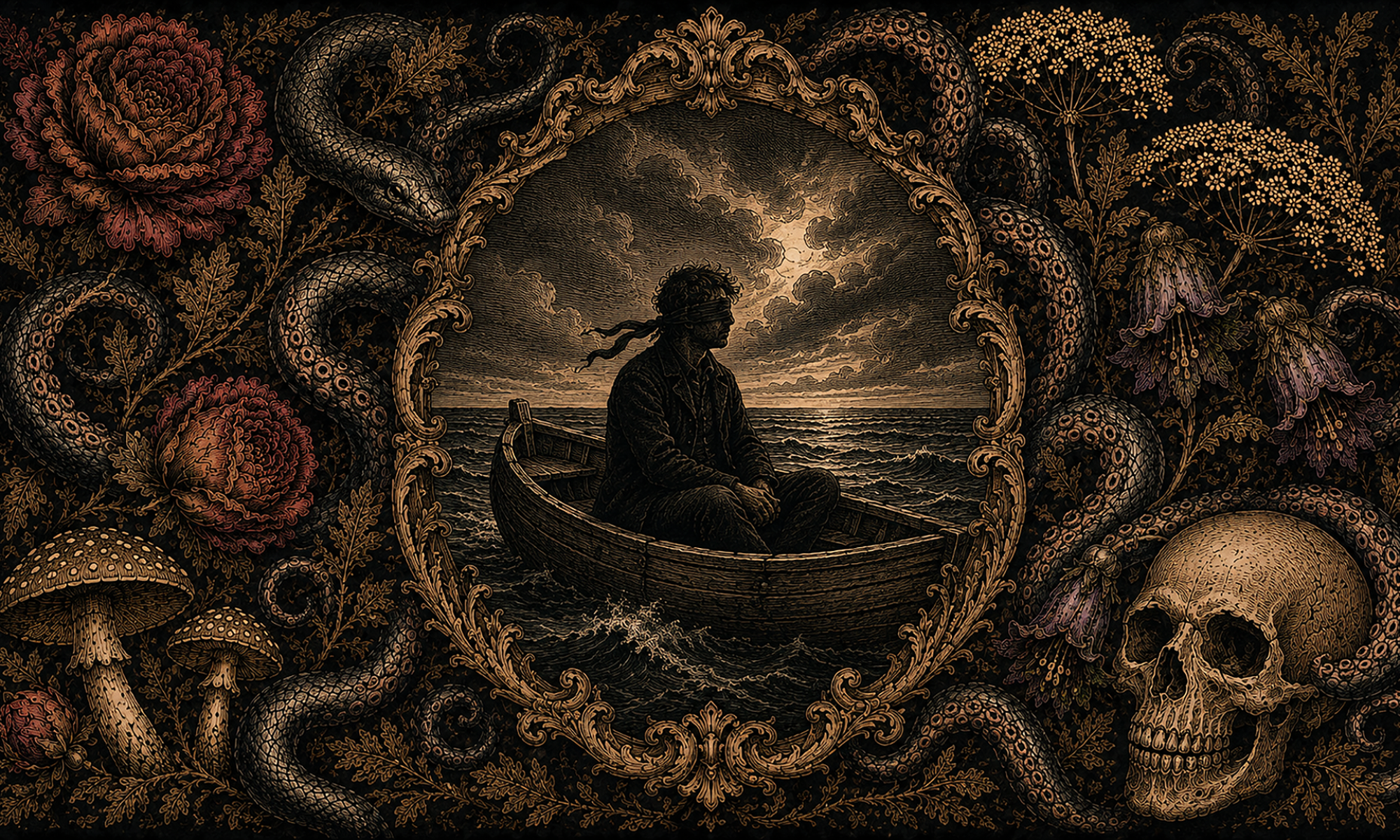
Grimvael is a mythical serpent of the mind, an imagined creature that feeds upon anxiety and dwells within forgotten memory. A vast black-scaled serpent of immeasurable length, his underbelly is lined with a thousand feeding suckers that cling to fear, grief, sorrow, and memory itself. He is my visual representation of anxiety made flesh (or scale).

He is not born of darkness alone, but weaponised by innermost emotions and our most intimate fears. In moments of panic, dread, or overwhelming anxiety, it is as though Grimvael feeds, coiling tighter, constricting, drawing life and energy from the very suffering he consumes.

Dark? Yes, perhaps.

Yet there is something strangely empowering in giving form to what once remained hidden, something invisible, unnamed, and shapeless. By giving anxiety a face, a body, a myth, it ceases to be an unseen force lurking in the shadows. Now, it is Grimvael.

I realise this may sound a little mad to some. But perhaps that is the quiet beauty of creativity and imagination: they grant us language for our fears, shape to our struggles, and sometimes, strength we never knew we possessed.

Grimvael concept